Trajan's Forum is the most important extensions of the Roman forum held between the end of the republic and the principle of imperial Rome, specifically between 107 and 112.

This Forum, the largest of the four Imperial Forums (Forum of Caesar, Forum of Nerva, Forum of Augustus and Trajan's Forum) erected near the Roman Forum, was designed by architect Apollodorus of Damascus, in charge of carrying out complex designed by the first emperor born outside of Italy, Marco Ulpius Sevillano Trajan.

Built around a square of 200x120 meters, was built Trajan's markets, a large semicircular area of \u200b\u200b6 commercial plants which were more than 150 shops spread over several levels which traded with different products, so it is considered as the first indoor mall ever.
At the lowest level, being in contact with the forum, was careful aesthetics and ornamentation of the facade, adding frescoes and mosaics ceilings and floors of these premises.
In the next two levels were the tabernae, a local-oriented forum in which they traded for food, oil, wine ...
The upper floors were occupied by Offces.

In another side of the square stood the Basilica forum Ulpia, which we can only see the remains of some columns between the bridge and the column of Trajan.

Behind the remains of the Basilica Ulpia we find the Trajan Column, a monument commemorating the victory of Emperor Trajan over the Dacians built in year 114.

With 38 meters high and 200 meters of bas-relief carved in a spiral that gives 23 laps to the column detailing each of the military campaigns of the emperor, this was the site chosen by the Trajan himself to his ashes should rest once dead.
In fact, when he died in the year 117, placed his ashes in a golden urn on the pedestal of the column, but now desonoce whereabouts of their ashes.
A curiosity of Trajan's column is that inside is a spiral staircase that allows access to the upper platform, but is not open to the public.
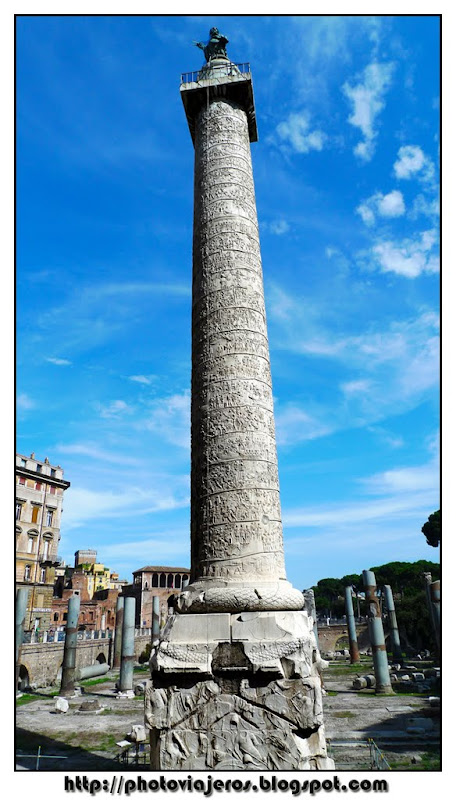
En el pedestal de 8 metros que soporta la columna, podemos ver la siguiente inscripción:
SENATVS·POPVLVSQVE·ROMANVS
IMP·CAESARI·DIVI·NERVAE·F·NERVAE
TRAIANO·AVG·GERM·DACICO·PONTIF
MAXIMO·TRIB·POT·XVII·IMP·VI·COS·VI·P·P·
AD·DECLARANDVM·QVANTAE·ALTITVDINIS
MONS·ET·LOCVS·TANT<...>IBVS·SIT·EGESTVS
La traducción aproximada sería la siguiente:
El senado y el pueblo romano, al emperador Caesar Nerva Trajan Augustus Germanicus Dacic, son of the divine Nerva, Pontifex Maximus, Tribune for the seventeenth time, Emperor for the sixth time, consul for the sixth time, the father of the nation, to show how high the mountain and the place now destroyed to
short, this inscription served to publicize the height of the hill that stood there before the construction of Trajan's Forum, for which they had to dig much of the Quirinal Hill in whose clearance was used to build most of the Trajan Market.


