Plaza Basilica de San Pedro y Museos
In the center of Rome near the Tiber, is the headquarters of the Catholic Church a walled compound that defines a city-state, the smallest in the world but also one of the most powerful and influential.
The most visited and interesting in this city-state is the Plaza and St. Peter's Basilica and the Vatican Museums .
The easiest way to get lossless is guided by the dome of St. Peter's Basilica is visible from many parts of the city of Rome, and the most used route is to walk through San't Angelo Bridge or Vittorio Emanuele II Bridge, which leaves us at the door of the Via della Conciliazione, with which arrive directly to the Plaza de San Pedro, one of the wonders of the great Bernini created between 1656 and 1667.
The square has a diameter of 240 meters and is surrounded by 4 rows of 284 columns on which there is a balustrade topped by 140 statues of saints of 3.20 meters each.
After a walk around the plaza, we headed to the queue to enter St. Peter's Basilica, which is normally quite long and we had to add the strict security measures because in that moment was the visit by the wife of President Obama with his daughters.
After nearly an hour of sun queue and go through the metal detector, we are at the doors of the basilica, so play to look at the square from this position, with the statues of St. Pedro and San Pablo back to us.
Before seeing the inside, just to remind you that the entry is free and no reservation needed.
The posters that are in the tail area warn that under the rules, will not let you if you try to enter in shorts or bare shoulders, and are prohibited for flash shots.
No such restrictions were applied the day I left, since 90% of those who entered the basilica went in shorts (very typical in the hot month of July) and inside the basilica were bursts of flash every few minutes, even if that I saw the guards to call attention to the odd photographer clueless.
All information on the Basilica of Saint Peter, in his official website:
http://www.vaticanstate.va/ES/Monumentos/Basilica_de_San_Pedro/Basilica.htm
Upon entering, the size of the Basilica make you feel small, very small.
are nothing more and nothing less than 190 meters long and 45.5 meters high in the area dome, and distributed across the central nave and two more on both sides, is 58 meters.
As areas are opened after the visit of Michelle Obama and family, we went to see the sculpture of Michelangelo's Pieta, made of marble and shows the Virgin Mary holding the dead body his son, lies in the first chapel to the right as we enter the front door.
Then we headed for the central area of \u200b\u200bthe basilica, where the altar under Bernini's Baldacchino, with the entrance to the tomb San Pedro is located just below.
Just behind the Baldacchino and end of the Basilica, is the apse, with a huge golden throne that contained the remains of a wooden chair in the tradition that used the same San Pedro.
Above the throne, there are two angels holding the symbols papal tiara and keys, opening a round window with a dove representing the Holy Spirit and which is surrounded by angels.
Under this set, is a shrine called "altar of the chair", where the pope celebrated certain ceremonies.
Baldacchino is the dome, also the work of Michelangelo, the highest point of the basilica and you can access to see wonderful views of the city.
Again, thanks to the Obama family visit, the dome was closed and we had to make do with admiring the inside, which is not bad.
From this position, we look to the front door and proved the enormous size of the Basilica.
Before leaving, one of the chapels is the marble slab where the names of all Popes of history and year of death, from St. Peter to John Paul II.
Finally, we had booked a visit to the tomb of St. Peter and the necropolis beneath the basilica, but after more than 2 hours of waiting, do not let us in for security reasons, again " thank you "to the visit being made by several members of the G8 to the Basilica.
is a very interesting visit, but you must book before you go, so the link you leave then you have all the necessary information: Book
visit to the tomb of St. Peter and the Vatican Necropolis
Saturday, April 30, 2011
Saturday, April 23, 2011
Teckdecklive.com Help
Vaticanos
The Vatican Museums are a private art collection of the Catholic church and having their origins in the private collection of statues that Cardinal Giuliano della Rovere was in the gardens of Belvedere Palace in 1503, the year he became pope under the name of Julius II.
Subsequently, various popes and wealthy Italian families were bringing more art and expand the facilities with new galleries and rooms to accommodate all this artistic treasure that we enjoy today thanks to this enormous collection of art is open to public.
The first is to indicate the entry since it is not accessed through the Plaza de San Pedro, but you have to give a "small" walk of about 10 to 15 minutes, so that the next map you can see way from St. Peter's Square to the entrance of the museum:
Once we reached the entrance, and even before, is very likely that we are with queue for the ticket, so I recommend taking entries taken from home.
may make a pre-booking of tickets through the website of the Vatican Museum where we can choose the date and time of our visit, but charge a fee of 4 €.
Entrance costs 14 € (summer 2009) and have to calculate about 3 hours for the visit.
What I did was to pre-book entry because it was not until we were paid a special box office showing where the email of the reservation and gave us the post itself.
How the day we went there was no line, we gain entry to the market price, thus avoiding paying € 4 charge and without showing the email of the reservation.
not know if this will remain the same, so to ensure you can see the latest prices, times and access to purchase online input from this link: http://mv.vatican.va/4_ES/pages/z-Info/MV_Info_Orari.html
With the entry into the hand, began a visit to the Vatican Museums for the gallery the carpets and maps.
As its name suggests, in these galleries we find large Flemish tapestries covering the walls, while in the gallery of maps, we can see about 40 maps of various regions of Italy painted on the walls of the gallery between 1580 and 1585.
Apart from the different regions are also represented major cities, such as this map of the city of Venice.
If we peer through the windows of those galleries, we can see the dome of St. Peter and Vatican part of the gardens:
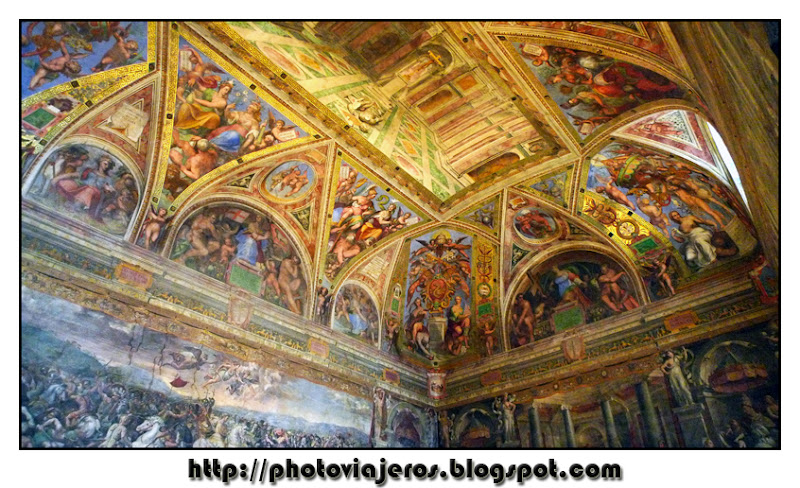
The next area we will visit will be Raphael's Rooms, four private rooms of Pope Julius II who commissioned to decorate the famous painter Raphael Sanzio and where we see some wonders such as:
Room of Constantine (1517-1525):
in this room are depicted various scenes from the life of Emperor Constantine, the first Roman emperor recognizing Christianity and decreed religious freedom.
highlights the main mural, called the Battle of Constantine against Maxentius, where is depicted the Battle of the Bridge Milvio held on 28 October 312 and the victory of Constantine over Maxentius.
the central square of the dome, designed by Tommaso Laureti, represents the victory of Christianity over paganism.
seal Stay (1508-1511):
One of the world's most famous frescoes, and one of the most important Rafael is in this room, The School of Athens.
In it displayed great philosophers, scientists and mathematicians of antiquity as Aristotle and Plato in the center, Ptolemy, Euclid and Pythagoras or even a portrait of the painter with the right hand side of the painting.
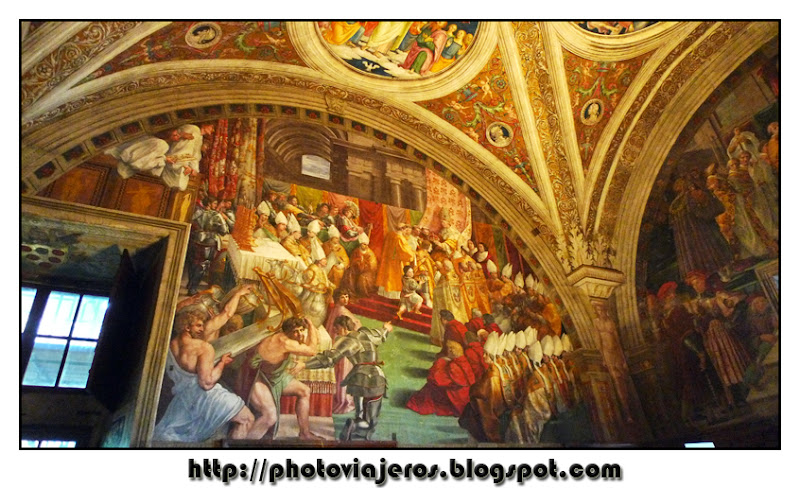
Fire Room of the Borgo (1514-1517):
From this room would highlight two of its frescoes, The Fire in the Borgo and the coronation of Charlemagne.
The first, The Fire in the Borgo, Pope Leo IV is leaning to the former St. Peter's making the sign of the cross and miraculously smothering fire during the year 847 in a neighborhood near the old basilica.
fresh
The other highlight of this room, the coronation of Charlemagne, illustrates the time Charlemagne was crowned in St. Peter's on Christmas Eve the year 800, thus becoming the foundation of the Holy Roman Empire.
All these rooms, you can see the virtual tour that provides us with the Vatican Museum in http://mv.vatican.va/4_ES/pages/SDR/SDR_00_Main.html
After
Rafael stays, we get to the Sistine Chapel, the place where the great Michelangelo Buonarroti painted some of his most famous works.
Sistine Chapel:
The name of the Sistine Chapel comes from the name used by the Pope Sixtus IV during his papacy, and is located on the right side of the basilica of San Pedro.
I will just not copy the vast amount of information that can be found in books, films and internet about this place because it would be virtually impossible to summarize so much data. There are many places where they can read about the frescoes, its meaning, its authors ... and where further much as we like about this room and impressive paintings, so I leave the choice of each information search on the Sistine Chapel and I'll just tell you my feelings and experience here. Upon entering
impressive to see so many people and an annoying hum pervades the room as much as the two guards insist that we lower the tone of voice.
To this we add the few lights of some crazy tourists taking pictures with flash, despite the express prohibition (leaving aside by pure logic and common sense should not do to preserve the paintings).
Once I get to abstract from this hostile environment, I begin to enjoy the show that five centuries ago shaped in every corner of this space about 40 feet long by 20 high geniuses such as Michelangelo and Botticelli.
On one side of the nave, is the 13x12 meter mural painted by Michelangelo depicting the Last Judgement.
In the vaulted ceiling can see other masterpieces by Michelangelo, 9 scenes from Genesis, among which are the separation of light from darkness, creating the stars and plants the formation of continents, the creation of Adam, the creation of Eve, original sin, and several scenes of Noah's flood.
Without doubt, the best known is the image located in the center of the dome, representing the creation of Adam, at the time that God touches his finger to give life.
I apologize for the quality of photography, but from the dim light and the number of people giving pushing was quite complicated to achieve this focus on the vault.
located in the walls under the windows, we can see the frescoes of artists such as Perugino where scenes from the life of Christ and Moses, and they occupy the place which tapestries were located Rafael stolen during the sack of Rome in 1527.
is not surprising that this is the place chosen by the conclave to elect a new pope with the famous white smoke.
To finish the Sistine Chapel, just say it would be better that access was more restricted and permission to enter only 20 or 30 people at a time in the room to be able to enjoy a place like this.
Following the marked route, we arrive at the Vatican Library, which could not be accessed and can only see the rich decoration of these rooms apparently without a specific use.
then navigate to the Art Gallery, located in one of the last buildings erected in the Vatican in 1939 and where we can see about five hundred paintings of the best Italian schools in chronological order over eighteen rooms ranging from the twelfth century until the late nineteenth century.
Among his works are some of Leonardo Da Vinci, Caravaggio, Giotto or Ticciano.
As in the Raphael Rooms, you can make a virtual visit to these rooms at the following link:
http://mv.vatican.va/4_ES/pages/x-Pano/PIN/Visit_PIN_Main.html
would highlight the room with pictures of Rafael VIII as "The Transfiguration", where Jesus Christ is depicted at the time of his transfiguration into Holy Spirit soon after helping a child demon that tries to be healed by the apostles, but they fail to work the miracle that Jesus Christ.
After visiting the rooms of the Pinacoteca, we access the collections of Egyptian and Etruscan Gregorian Museum, where we can see many objects of everyday life Egyptian and Roman statues, reliefs, sarcophagi and mosaics excavations or donations from private collectors.
From here you access the patio of the Pineapple, where we with more Greco-Roman sculptures and the odd golden ball in the center.
Among the sculptures that stand out from the area of \u200b\u200bMuseums, is that of Laocoon and his sons, a sculpture of almost 3 meters high made of marble and dating of the first century
It shows the Trojan priest Laocoon, who first uncovered the deception of the Trojan horse, writhing in pain and about to die along with their children, victims of snakes emerging from the sea.
To end the visit to the Vatican Museums, leave the premises by a modern spiral ramp that will give us the main entrance.
The Vatican Museums are a private art collection of the Catholic church and having their origins in the private collection of statues that Cardinal Giuliano della Rovere was in the gardens of Belvedere Palace in 1503, the year he became pope under the name of Julius II.
Subsequently, various popes and wealthy Italian families were bringing more art and expand the facilities with new galleries and rooms to accommodate all this artistic treasure that we enjoy today thanks to this enormous collection of art is open to public.
The first is to indicate the entry since it is not accessed through the Plaza de San Pedro, but you have to give a "small" walk of about 10 to 15 minutes, so that the next map you can see way from St. Peter's Square to the entrance of the museum:
Once we reached the entrance, and even before, is very likely that we are with queue for the ticket, so I recommend taking entries taken from home.
may make a pre-booking of tickets through the website of the Vatican Museum where we can choose the date and time of our visit, but charge a fee of 4 €.
Entrance costs 14 € (summer 2009) and have to calculate about 3 hours for the visit.
What I did was to pre-book entry because it was not until we were paid a special box office showing where the email of the reservation and gave us the post itself.
How the day we went there was no line, we gain entry to the market price, thus avoiding paying € 4 charge and without showing the email of the reservation.
not know if this will remain the same, so to ensure you can see the latest prices, times and access to purchase online input from this link: http://mv.vatican.va/4_ES/pages/z-Info/MV_Info_Orari.html
With the entry into the hand, began a visit to the Vatican Museums for the gallery the carpets and maps.
As its name suggests, in these galleries we find large Flemish tapestries covering the walls, while in the gallery of maps, we can see about 40 maps of various regions of Italy painted on the walls of the gallery between 1580 and 1585.
Apart from the different regions are also represented major cities, such as this map of the city of Venice.
If we peer through the windows of those galleries, we can see the dome of St. Peter and Vatican part of the gardens:
The next area we will visit will be Raphael's Rooms, four private rooms of Pope Julius II who commissioned to decorate the famous painter Raphael Sanzio and where we see some wonders such as:
Room of Constantine (1517-1525):
in this room are depicted various scenes from the life of Emperor Constantine, the first Roman emperor recognizing Christianity and decreed religious freedom.
highlights the main mural, called the Battle of Constantine against Maxentius, where is depicted the Battle of the Bridge Milvio held on 28 October 312 and the victory of Constantine over Maxentius.
the central square of the dome, designed by Tommaso Laureti, represents the victory of Christianity over paganism.
seal Stay (1508-1511):
One of the world's most famous frescoes, and one of the most important Rafael is in this room, The School of Athens.
In it displayed great philosophers, scientists and mathematicians of antiquity as Aristotle and Plato in the center, Ptolemy, Euclid and Pythagoras or even a portrait of the painter with the right hand side of the painting.
Fire Room of the Borgo (1514-1517):
From this room would highlight two of its frescoes, The Fire in the Borgo and the coronation of Charlemagne.
The first, The Fire in the Borgo, Pope Leo IV is leaning to the former St. Peter's making the sign of the cross and miraculously smothering fire during the year 847 in a neighborhood near the old basilica.
fresh
The other highlight of this room, the coronation of Charlemagne, illustrates the time Charlemagne was crowned in St. Peter's on Christmas Eve the year 800, thus becoming the foundation of the Holy Roman Empire.
All these rooms, you can see the virtual tour that provides us with the Vatican Museum in http://mv.vatican.va/4_ES/pages/SDR/SDR_00_Main.html
After
Rafael stays, we get to the Sistine Chapel, the place where the great Michelangelo Buonarroti painted some of his most famous works.
Sistine Chapel:
The name of the Sistine Chapel comes from the name used by the Pope Sixtus IV during his papacy, and is located on the right side of the basilica of San Pedro.
I will just not copy the vast amount of information that can be found in books, films and internet about this place because it would be virtually impossible to summarize so much data. There are many places where they can read about the frescoes, its meaning, its authors ... and where further much as we like about this room and impressive paintings, so I leave the choice of each information search on the Sistine Chapel and I'll just tell you my feelings and experience here. Upon entering
impressive to see so many people and an annoying hum pervades the room as much as the two guards insist that we lower the tone of voice.
To this we add the few lights of some crazy tourists taking pictures with flash, despite the express prohibition (leaving aside by pure logic and common sense should not do to preserve the paintings).
Once I get to abstract from this hostile environment, I begin to enjoy the show that five centuries ago shaped in every corner of this space about 40 feet long by 20 high geniuses such as Michelangelo and Botticelli.
On one side of the nave, is the 13x12 meter mural painted by Michelangelo depicting the Last Judgement.
In the vaulted ceiling can see other masterpieces by Michelangelo, 9 scenes from Genesis, among which are the separation of light from darkness, creating the stars and plants the formation of continents, the creation of Adam, the creation of Eve, original sin, and several scenes of Noah's flood.
Without doubt, the best known is the image located in the center of the dome, representing the creation of Adam, at the time that God touches his finger to give life.
I apologize for the quality of photography, but from the dim light and the number of people giving pushing was quite complicated to achieve this focus on the vault.
located in the walls under the windows, we can see the frescoes of artists such as Perugino where scenes from the life of Christ and Moses, and they occupy the place which tapestries were located Rafael stolen during the sack of Rome in 1527.
is not surprising that this is the place chosen by the conclave to elect a new pope with the famous white smoke.
To finish the Sistine Chapel, just say it would be better that access was more restricted and permission to enter only 20 or 30 people at a time in the room to be able to enjoy a place like this.
Following the marked route, we arrive at the Vatican Library, which could not be accessed and can only see the rich decoration of these rooms apparently without a specific use.
then navigate to the Art Gallery, located in one of the last buildings erected in the Vatican in 1939 and where we can see about five hundred paintings of the best Italian schools in chronological order over eighteen rooms ranging from the twelfth century until the late nineteenth century.
Among his works are some of Leonardo Da Vinci, Caravaggio, Giotto or Ticciano.
As in the Raphael Rooms, you can make a virtual visit to these rooms at the following link:
http://mv.vatican.va/4_ES/pages/x-Pano/PIN/Visit_PIN_Main.html
would highlight the room with pictures of Rafael VIII as "The Transfiguration", where Jesus Christ is depicted at the time of his transfiguration into Holy Spirit soon after helping a child demon that tries to be healed by the apostles, but they fail to work the miracle that Jesus Christ.
After visiting the rooms of the Pinacoteca, we access the collections of Egyptian and Etruscan Gregorian Museum, where we can see many objects of everyday life Egyptian and Roman statues, reliefs, sarcophagi and mosaics excavations or donations from private collectors.
From here you access the patio of the Pineapple, where we with more Greco-Roman sculptures and the odd golden ball in the center.
Among the sculptures that stand out from the area of \u200b\u200bMuseums, is that of Laocoon and his sons, a sculpture of almost 3 meters high made of marble and dating of the first century
It shows the Trojan priest Laocoon, who first uncovered the deception of the Trojan horse, writhing in pain and about to die along with their children, victims of snakes emerging from the sea.
To end the visit to the Vatican Museums, leave the premises by a modern spiral ramp that will give us the main entrance.
Subscribe to:
Posts (Atom)